
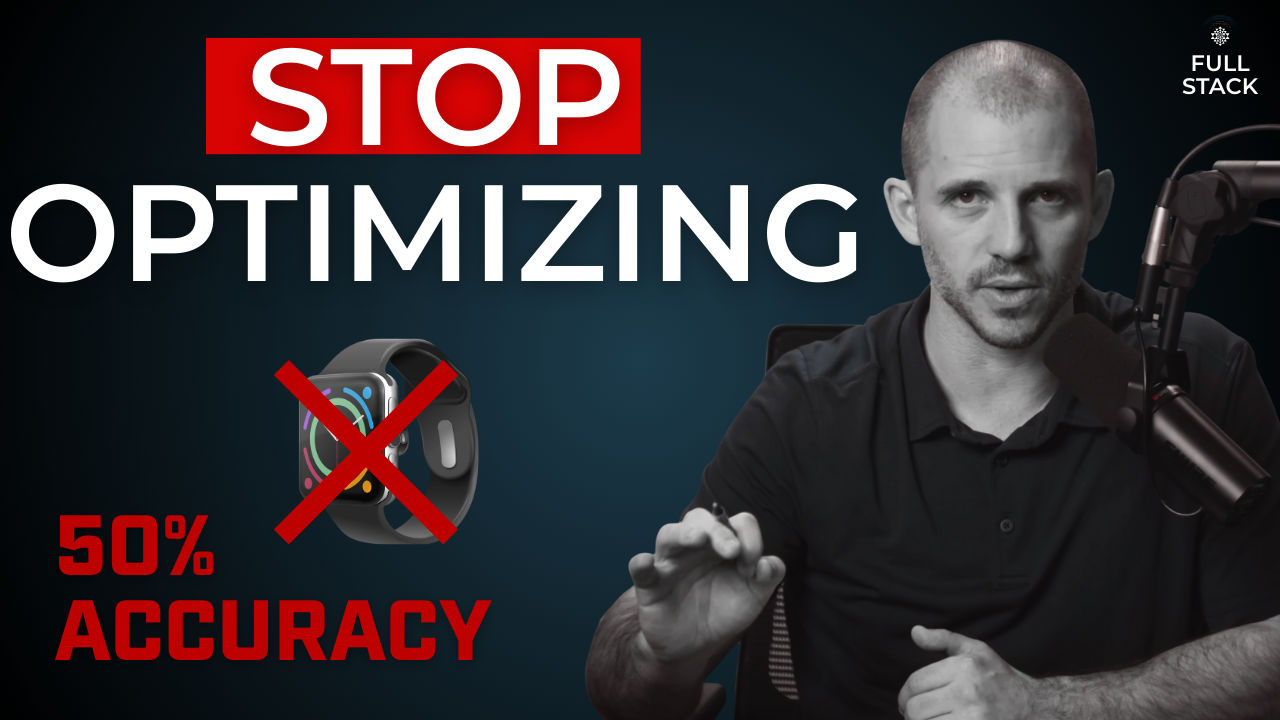
If you’re a high performer who tracks sleep religiously, this might feel uncomfortable to read.
Because according to Dr. Andy Galpin, one of the world’s leading human performance scientists, the very thing you’re using to improve recovery may be quietly making it worse.
In a recent episode of The Full Stack Podcast, Galpin broke down a growing problem he’s seeing in entrepreneurs, executives, and elite athletes:
The obsession with sleep optimization.
Not sleep itself.
Not rest.
But the data-driven fixation on perfect numbers.
And the cost is higher than most people realize.
The Rise of Sleep Optimization (And Why It Backfires)
Wearables like Oura, Whoop, Apple Watch, and Garmin promise clarity.
They tell you how long you slept.
How much deep sleep you got.
How “recovered” you are today.
For driven people, that information feels empowering.
Until it isn’t.
Galpin explains that when people begin letting a score determine how they feel, how they train, or how capable they believe they are that day, the nervous system starts to shift into vigilance.
Tight chest.
Racing mind.
Subtle anxiety before your feet even hit the floor.
That’s not recovery.
That’s pressure.
Orthosomnia: When Tracking Causes Insomnia
There’s a clinical term for this pattern.
Orthosomnia.
Galpin defines it as tracker-induced insomnia—a condition where the anxiety of trying to optimize sleep actually degrades sleep quality over time.
The body doesn’t rest when it’s being monitored.
It rests when it feels safe.
And constant measurement often communicates the opposite signal.
Why Sleep Tracker Data Is Less Reliable Than You Think
One of the most surprising insights from Galpin’s research is just how imprecise consumer sleep data really is.
In some cases:
- Deep sleep readings can have error margins of ±70 minutes
- Different devices disagree with each other regularly
- Even clinical sleep experts only align about 80% of the time when staging sleep
In Galpin’s words, many people are making real-life decisions based on:
“Randomness on top of randomness.”
Training less.
Canceling meetings.
Second-guessing themselves.
Not because their body said so—but because a device did.
Recovery Is Not the Same as Sleep
Another critical distinction Galpin emphasizes: sleep and recovery are not identical.
Sleep is one input.
Recovery is the outcome of multiple systems working together:
- Nervous system state
- Psychological load
- Emotional stress
- Decision fatigue
- Novelty exposure (scrolling, email, TikTok)
You can technically sleep eight hours and still wake up depleted.
And you can sometimes sleep less and feel remarkably resilient.
Context matters more than numbers.
The Quadrant System: A Reality Check for High Performers
To help people see where their energy is actually going, Galpin uses a simple but confronting framework he calls The Quadrant System.
You have 10 total points to allocate across four areas:
- Business
- Health
- Relationships
- Recovery
Most high achievers unknowingly overspend in one quadrant while starving the others.
Galpin isn’t moralizing this.
He’s naming a constraint.
You can’t be a 10/10 everywhere at once.
But you can be honest.
And honesty is the first step toward sustainable performance.
Why Novelty Is the Real Enemy of Rest
Blue light often gets blamed for poor sleep.
Galpin points to something else entirely:
Novelty.
The endless search for stimulation—emails, feeds, short-form video—keeps the brain in a state of arousal.
The body doesn’t fall asleep because it’s tired.
It falls asleep because the world becomes boring enough.
When novelty exceeds the interest of sleep, rest loses.
Stop Optimizing. Start Listening.
The core message of Galpin’s work isn’t anti-technology.
It’s anti-dependence.
Data should inform.
Not dominate.
When you outsource authority to a device, you train yourself to distrust your own perception.
When you rebuild sensitivity—to breath, fatigue, mood, and presence—you regain something far more valuable than perfect sleep metrics.
You regain agency.
Watch the Full Conversation with Dr. Andy Galpin
This article only scratches the surface of the conversation.
In the full episode of The Full Stack Podcast, we go deeper into:
- High-performance decision-making
- Nervous system resilience
- The difference between being busy and being effective
- Why true recovery starts with awareness, not optimization
👉 Watch the full episode here:
If sleep tracking has ever made you feel tighter instead of calmer, this conversation will feel like permission to exhale.
About The Full Stack Podcast
Hosted by Mike Bledsoe and Ted Phaëton, The Full Stack Podcast explores the integration of business, health, relationships, and purpose for entrepreneurs who know that grinding harder isn’t the answer.
Clarity over chaos.
Presence over pressure.