
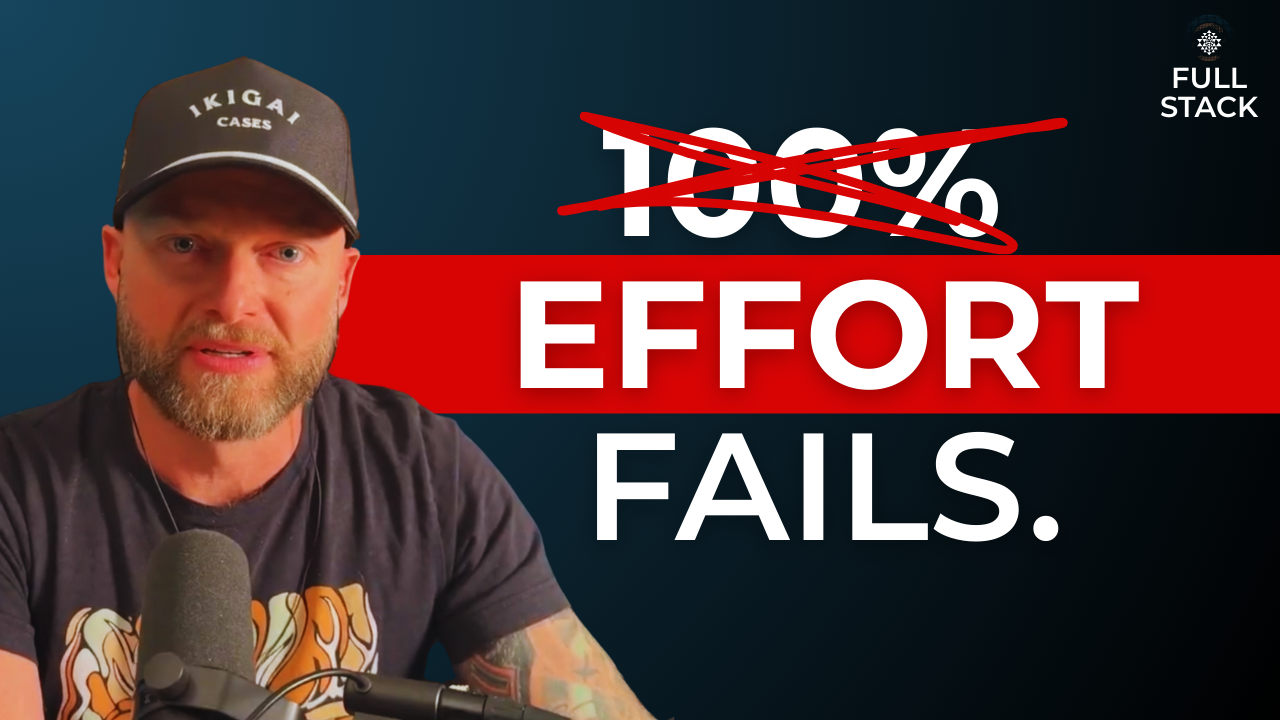
Most people don’t burn out because they’re weak.
They burn out because they were taught the wrong performance model.
If you’ve ever felt constantly tired but guilty when you slow down… If rest feels uncomfortable instead of restorative… If your productivity swings between overdrive and shutdown…
You’re not lazy. And you’re not broken.
You’re likely running on a 100% effort myth that quietly erodes clarity, focus, and long-term performance.
In a recent episode of The Full Stack Response, Ted Phaeton and I break down why giving 100% every day doesn’t create excellence – it creates exhaustion – and what to do instead.
👉 Watch the full conversation here:
The Hidden Cost of Hustle Culture
For years, high performers have been rewarded for pushing harder, doing more, and overriding their bodies.
The message is subtle but constant:
- If you’re tired, push through.
- If you rest, you’re falling behind.
- If you’re not giving everything, you don’t want it badly enough.
The problem?
Your nervous system doesn’t interpret that as ambition.
It interprets it as threat.
Over time, that threat response shows up as:
- Brain fog and reduced creativity
- Chronic fatigue masked as “lack of motivation”
- Guilt around rest and recovery
- Dependency on caffeine, stimulation, or productivity hacks
What looks like a performance issue is often a regulation issue underneath.
Why 100% Effort Shrinks Your Capacity
In the episode, I explain a counterintuitive truth used by elite athletes and long-term performers:
If you operate at 100% every day, you lose access to your real 100% when it actually matters.
The body needs variation.
Without downshifts, there is no reserve. Without reserve, there is no peak.
This is why people who “work hard all the time” often feel dull, reactive, or stuck – even when they’re technically productive.
They’ve trained themselves out of resilience.
The 80% Rule: A Better Model for Sustainable Performance
The alternative isn’t doing less.
It’s doing things with precision.
The 80% Rule is a framework where effort is intentionally modulated across time instead of maxed out every day.
In the conversation, I outline how this looks in real life:
- Some days naturally demand higher output
- Other days require intentional recovery or lighter load
- The average effort stays around 80%
The result?
When a true 100% day is needed – a launch, a competition, a deep creative push – the capacity is actually available.
This isn’t about motivation.
It’s about energy management and nervous system literacy.
Rest vs. Avoidance: How to Tell the Difference
One of the most common fears people have is:
“What if I’m just avoiding discomfort?”
The episode tackles this directly.
True rest doesn’t feel like collapse. Avoidance doesn’t feel calm.
I share simple tests to distinguish between the two – including brief body-based check-ins and time-bound effort experiments – that help remove guilt from rest while preserving integrity.
When you can feel the difference, you stop outsourcing discipline to shame.
Productivity Hacks vs. Alignment
Another key insight from the conversation is how many modern productivity tools are really just anxiety management strategies.
Microdosing. Endless supplements. More tracking. More optimization.
These tools can temporarily increase output – but often at the cost of deeper misalignment.
As Mike points out, sharpening the edge of work you fundamentally resist doesn’t fix the root issue.
Alignment does.
Who This Conversation Is For
This episode will resonate if:
- You’re driven but feel chronically tight or on edge
- Rest creates guilt instead of relief
- Your results don’t match the effort you’re putting in
- You want sustainable excellence, not short-term spikes
This isn’t about slowing down.
It’s about becoming more precise with your energy, attention, and output.
Watch the Full Episode
The full conversation goes deeper into:
- Nervous system awareness for high performers
- How elite performers structure effort over time
- The difference between laziness and a body asking for recalibration
- Why long-term success depends on restraint as much as drive
👉 Watch The Full Stack Response episode here
If something in this conversation lands, pay attention to the physical response – not just the ideas.
Your body often recognizes truth before your mind does.
Stay stacked,
Mike Bledsoe